eSIM vs Classic SIM Card: The Hidden Truth About KYC, Roaming Tariffs & Privacy
You land in Istanbul at 11 PM. Exhausted, you head to the airport SIM kiosk. The vendor asks for your passport. He scans it. He types your IMEI into a government database. He takes a photo of your face. Twenty minutes later — if you are lucky — you walk away with a working SIM card.
Meanwhile, the traveler behind you in the queue pulled out their phone, opened an app, scanned a QR code, and had working internet before the plane even landed. No passport shown. No biometrics taken. No IMEI registered with a foreign government.
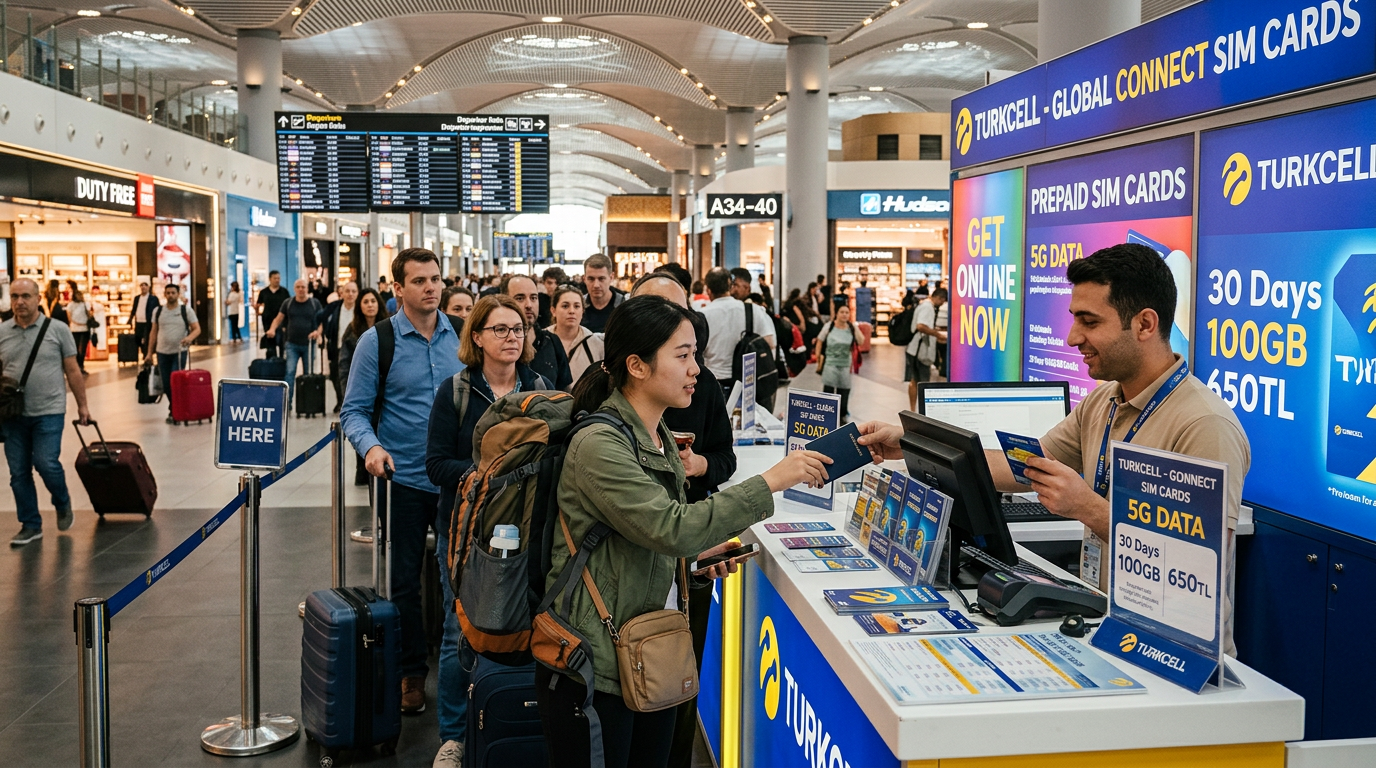
The difference between an eSIM and a classic SIM card is not just about hardware. It is about two completely different legal, financial, and privacy realities — and most travelers do not understand the gap until they are standing in that airport queue, or opening a shocking roaming bill a month later.
This guide breaks down what actually changes when you choose one over the other — with real numbers, real country-by-country KYC rules, and an honest look at what each option reveals about you. If you are already convinced and just want to skip the hassle, browse our eSIM plans for 170+ countries and activate in 30 seconds.
The Quick Technical Difference Between eSIM and Physical SIM
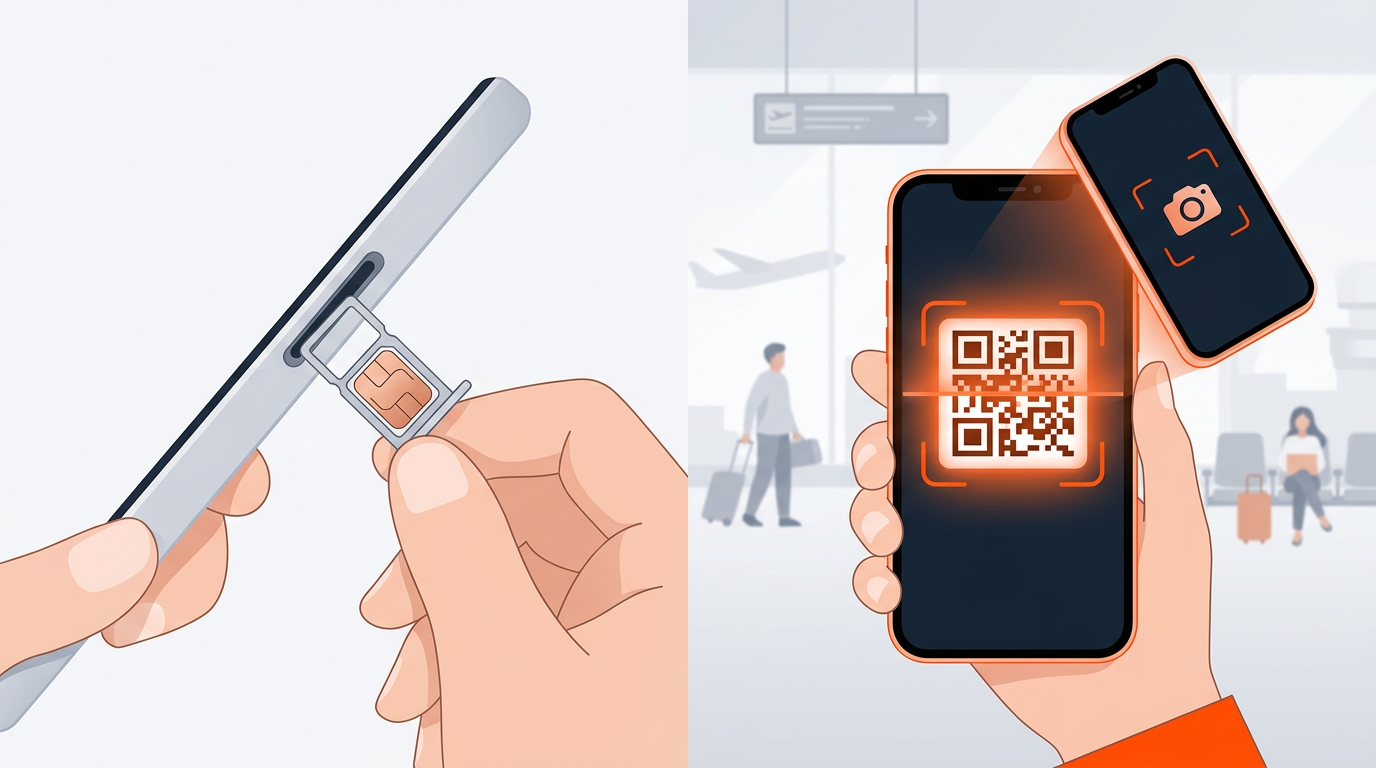
A classic SIM card is a small plastic chip you insert into your phone. An eSIM (embedded SIM) is a digital profile downloaded onto a chip already built into your device — activated with a QR code or one-tap installation through an app.
That is where the obvious story ends. The real story — the one this article is about — is what happens around the technology: the regulations, the pricing structures, and the data trails each option creates. If you are new to eSIM activation, our setup guide walks you through the entire process in under a minute.
Key takeaway: The hardware difference is trivial. The real gap is in KYC requirements, roaming costs, and how much personal data each option shares with foreign governments.
KYC Reality Check: Why Your Passport Matters More Than You Think
What Is SIM Card KYC Registration and Why Does It Exist?
KYC stands for Know Your Customer. In banking it means proving your identity to open an account. In telecommunications it means the same thing — proving who you are before a SIM card is activated in your name.
More than 160 countries now require mandatory SIM card registration, and over 35 of them require biometrics such as fingerprints or facial scans. The stated reasons are fraud prevention, anti-terrorism, and national security.
The controversy? When Germany tightened its SIM registration rules in 2017, researchers could find no measurable difference in crime rates. Critics argue these systems serve mass surveillance far more than they prevent crime. But whatever the intent, the burden falls on ordinary travelers.
Countries Where You Will Need Documents for a Local SIM (2026)
Here is a practical snapshot of what you can expect in some of the most visited destinations — click any country below to jump directly to eSIM plans that skip the KYC process entirely:
| Country | What You Need | Biometrics? | SIM Limit |
|---|---|---|---|
| Turkey | Passport + IMEI registration | Passport scan | 1 foreign SIM |
| India | Passport, visa, hotel address, local reference | Yes (fingerprint + photo) | 1 for tourists |
| China | Passport + local address | Yes (facial scan) | Varies |
| UAE | Emirates ID or passport | Yes | 1 per tourist |
| Saudi Arabia | Passport + biometrics | Yes | 1 per tourist |
| Thailand | Passport + photo | Sometimes | 3 |
| Vietnam | Passport | No | 3 |
| Bosnia & Herzegovina | Passport required for prepaid | No | No limit |
| Germany | ID or passport | No | No limit |
| United States | Usually none | No | No limit |
Rwanda and the UAE currently have the strictest limits — each allows only one SIM card per visitor, registered to your passport. In India, the process can take hours: you may need not just your passport and visa, but a printed hotel booking and in some cases a local reference contact.
The Hidden Problem: How Long Is Your Personal Data Stored?
Registering a SIM card is only the first step. The second is retention. Nigeria retains user data for three years. Pakistan keeps it for one year. Burundi has no specified retention period at all — and without a data protection law, that means indefinitely.
In practical terms: every call, every SMS, every cell tower your phone pinged, tied to your name and passport number, sitting in a database you have no access to, for years after you have left the country.
How eSIM Changes the KYC Registration Equation
Here is the part most travelers do not realize: most international eSIM providers do not require KYC at all for the destination country. Why? Because you are not technically registering a local subscriber line — you are roaming on a foreign partner network through your eSIM provider's home licensing. When you use a UpApp Thailand eSIM, for example, the Thai telecom authority sees a roaming user from the eSIM provider's network — not a new local customer to register. Your passport stays in your pocket.
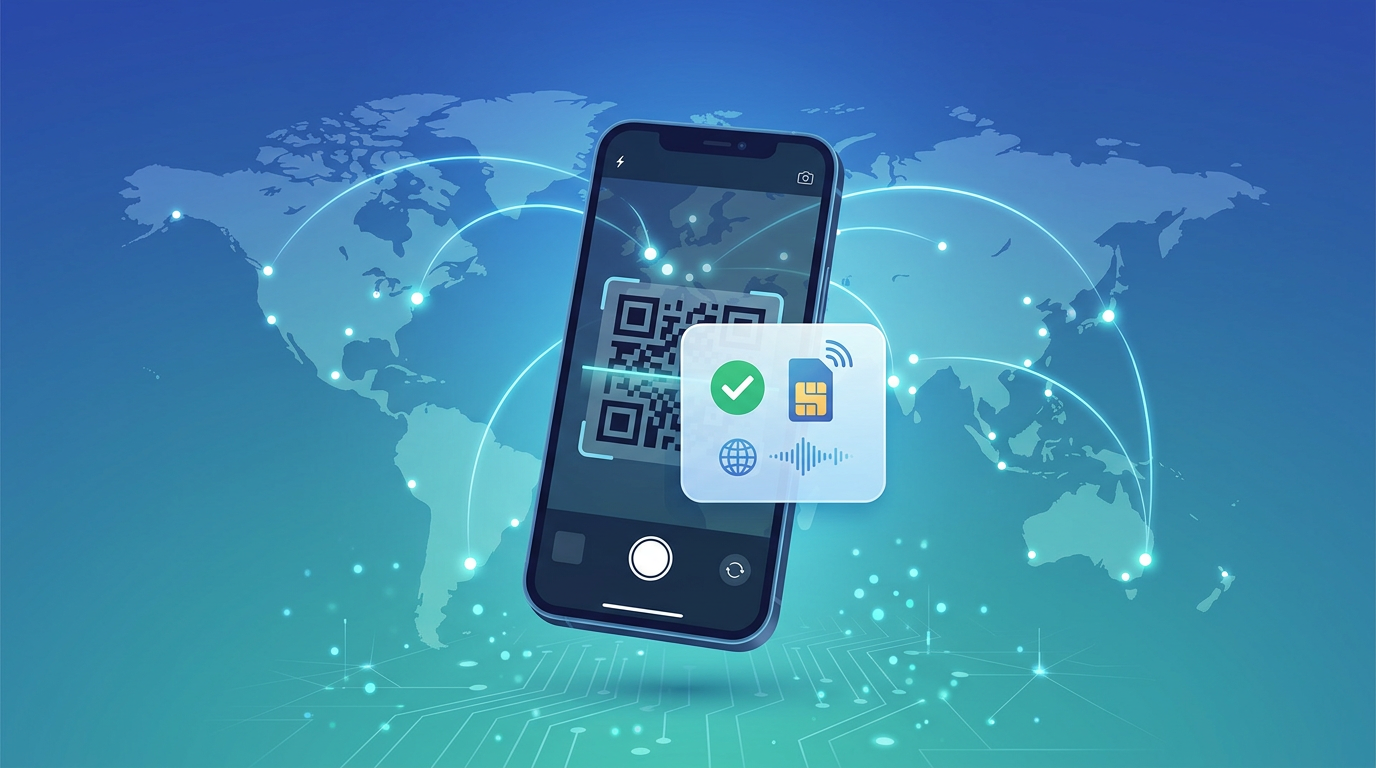
An important caveat: this is changing. Turkey, China, and India have started tightening rules on international eSIM providers, and some countries now block eSIM services they consider unlicensed. Always check your destination before you travel — choose a provider with verified, active connectivity in the country you are visiting.
Roaming Tariffs: The Pricing Trap Your Carrier Does Not Advertise
What International Roaming Actually Costs in 2026
Here is what most travelers do not realize until the bill arrives. Roaming pricing is not just expensive — it is deliberately opaque. Domestic carriers rarely show the real per-megabyte cost in their apps, preferring to sell daily passes that sound cheap but add up fast.
- EU traveler inside the EU: Roam Like at Home — free up to a fair use limit, after which surcharges apply.
- EU traveler outside the EU: typically 3 to 15 euros per megabyte without a pass, or 5 to 15 euros per day for a travel pass.
- US traveler in Europe: Verizon TravelPass around $10 per day. T-Mobile offers free international data but throttles to 2G speeds — technically free, practically unusable.
- Balkans traveler outside the EU: often 5 to 10 KM or HRK per megabyte. A handful of uploaded photos can cost more than the flight.
The eSIM vs Roaming Price Comparison (Real Numbers)
Let us compare the actual cost of 5GB of data in Thailand for a week-long trip:
| Option (5GB in Thailand, 7 days) | Typical Price | Activation Time |
|---|---|---|
| Roaming with home carrier | $50 – $150 | Already active (at a cost) |
| Local SIM at airport | $15 – $25 + KYC hassle | 15 – 45 minutes |
| UpApp Thailand eSIM | $10 – $18 | 30 seconds |
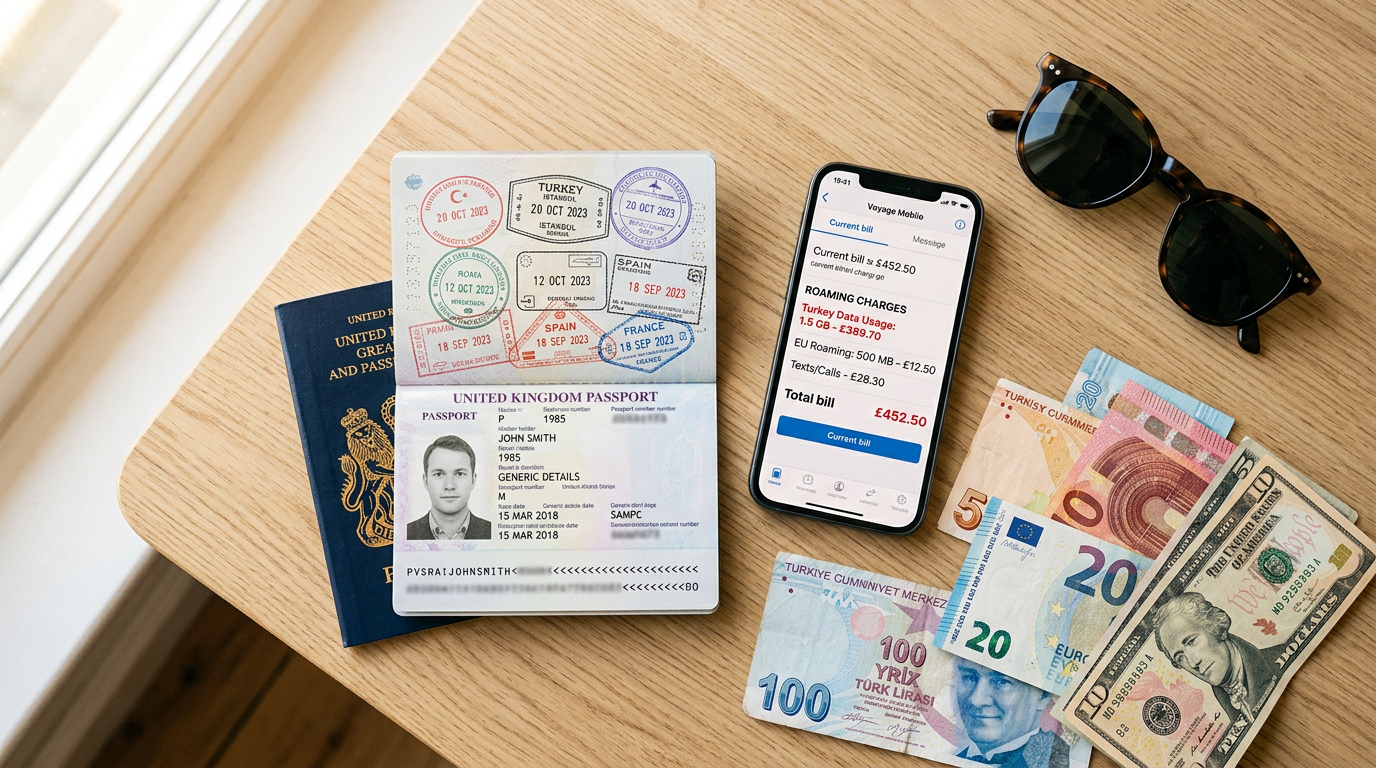
The eSIM is not just cheaper by a small margin. It is cheaper by a factor of five to ten compared to roaming, with no hidden surcharges, no bill shock, and no airport queue. And the pricing is transparent — you see the exact cost before you pay, not in a surprise bill three weeks later.
The Fair Use Trap in EU Roaming
Many European travelers assume EU roaming is completely free. It is not. Roam Like at Home comes with a fair use policy that limits how much data you can consume at domestic prices. Exceed it, and your operator can apply surcharges or throttle your speed. For a Croatian user visiting Spain for two weeks, that fair use allowance can evaporate by day ten. An eSIM with a local Spanish data package, by contrast, gives you the full volume you paid for — no hidden ceiling.
For multi-country European trips, our regional eSIM plans cover 41 countries on a single package.
eSIM Privacy vs Physical SIM: What Each Type Reveals About You
What Your Physical SIM Tells the Local Government
When you buy and register a local SIM card with your passport, here is what happens to your data:
- Your name, passport number, and local address (often the hotel) are tied to your new phone number and IMSI.
- Your device's IMEI is often registered alongside — locking your phone itself to your identity in that country.
- Your call and messaging metadata — who you contacted, when, for how long, from which cell towers — is stored by the operator.
- Local authorities can compel the operator to hand over that data, often without a warrant in countries with weak privacy frameworks.
- Retention periods range from one to three years, with some countries having no legal limit at all.
What an eSIM Reveals About Your Identity (and What It Does Not)
With an international eSIM, the data picture looks different:
- Your home eSIM provider knows your identity through your payment and account information.
- The local roaming partner sees a "roaming user from network X" — not a newly registered local customer with a passport attached.
- Your identity is not directly entered into the destination country's telecom registry.
- Your IMEI is shared with the roaming network for authentication, but not typically stored in the local country's long-term IMEI database.
Privacy bottom line: An eSIM is not anonymous — your payment method and metadata still exist somewhere. But compared to a local SIM registered to your passport, an eSIM is dramatically less invasive in terms of what the country you are visiting knows about you.
The IMEI Registration Question
Many countries — Turkey being the textbook example — tie your device's IMEI to the SIM you register. Swap that SIM for another one later, and the IMEI stays linked to your original identity record. This creates a long-term link between your hardware and your passport in a foreign government's database.
eSIMs do not create this same direct registration link. Your IMEI is used for network authentication but is not written into the local KYC record the same way.
When a Classic Physical SIM Card Still Wins (Yes, Really)
This article is not a sales pitch. There are genuine situations where a local physical SIM is the better choice:
- Long-term stays (30+ days in one country): a local plan is usually cheaper than stacking multiple eSIM top-ups.
- When you need a local phone number: bank verifications, local taxi apps (Yandex, Didi, Grab in some regions), and local services often require a local number for SMS codes.
- Countries with poor eSIM support: some destinations have limited or expensive international eSIM coverage, making a local SIM more practical.
- Older devices without eSIM support: iPhones before the XS (2018) and Android phones before roughly 2019 generally do not support eSIM.
- Best per-GB local pricing: in markets like India, local prepaid bundles are genuinely among the cheapest in the world — if you can navigate the KYC process.
When an eSIM Is the Better Choice (Most Travelers, Most of the Time)
- Short to medium trips (2 to 21 days) — the activation and pricing convenience wins by a landslide.
- Multi-country itineraries — a regional eSIM package covers several countries on one plan.
- Destinations with strict KYC or biometric requirements — India, China, UAE, Saudi Arabia — an eSIM lets you skip the process entirely.
- Late arrivals — airport SIM kiosks close. Your eSIM activates at 3 AM just as easily as at noon.
- When you need to keep your home number active — dual SIM setups let you receive SMS codes from your bank while using data on the eSIM.
- When you value travel privacy — your passport does not enter a new country's telecom registry.
eSIM vs SIM Decision Framework: Four Questions to Ask Yourself
- How long am I staying? Under 21 days: eSIM. Over 30 days: consider a local SIM.
- Do I need a local phone number? If yes for local services: local SIM. If just data and messaging: eSIM.
- Does my destination have strict KYC? If yes (India, China, UAE, Saudi Arabia): eSIM avoids the entire process.
- Am I an EU citizen staying inside the EU? Roaming is fine for short stays. For longer trips, an eSIM avoids fair use throttling.
Frequently Asked Questions
Do I need to register my eSIM with a passport?
Most international eSIM providers do not require KYC registration, because you are technically roaming on a foreign network rather than signing up as a local customer. That said, some countries — Turkey, China, India — are tightening rules. Always check your destination before traveling.
Is an eSIM more private than a physical SIM card?
In the country you are visiting, yes. Your identity is not directly registered in the local telecom authority's database. However, your eSIM provider still holds your payment and account information — an eSIM is more private than a local SIM, but not anonymous.
Which is cheaper for international travel — eSIM or roaming?
An eSIM is almost always cheaper than roaming with your home carrier, often by 70 to 90 percent. A local SIM can be cheaper per gigabyte for long stays, but you need to factor in time, KYC paperwork, and language barriers.
Can I use an eSIM in countries that require SIM registration?
In most cases, yes. eSIM providers handle the network connection through their own licensing agreements, so you do not personally register with the local authority. The exceptions are countries that have actively blocked specific international eSIM providers — check before you travel.
Does my eSIM work if a country blocks my provider?
If a country has blocked your specific eSIM provider's network routing, your plan will not work there. This has become an issue in Turkey, where regulators blocked dozens of international eSIM services. Choose a provider with active, licensed connectivity in your destination.
Is my phone IMEI registered when I use an eSIM abroad?
Your IMEI is shared with the roaming network for authentication, but it is not typically registered in the destination country's long-term IMEI database the way a locally-purchased SIM would be.
The Bottom Line: eSIM vs SIM Card for Travel in 2026
A classic SIM card integrates you deeply into a country's local telecom system — with all the convenience and all the surveillance that comes with it. An eSIM keeps you at a regulatory distance: faster, cheaper, more private for most travelers, but not a magic solution.
The smartest travelers often combine both. Keep your home number active on your physical SIM for bank SMS codes and emergency contacts. Add an eSIM for data and local connectivity. You get the best of both worlds: familiar communication with your life back home, and flexible, affordable, low-paperwork connectivity wherever you land.
Browse UpApp eSIM plans for 170+ countries or explore our regional multi-country packages. Activate in 30 seconds with our step-by-step setup guide. Travel connected, the smart way.