
Digital Nomad's Guide to Staying Connected in the Mediterranean: eSIM Strategy for Multi-Country Trips
Coffee in Lisbon in March. Coworking in Barcelona in April. A week on the Amalfi coast in May. Island hopping in Greece through June. A side trip to Istanbul before summer ends. Somewhere along the way, you realize your "work from anywhere" dream is really a "work from anywhere that has stable mobile data" dream.

The Mediterranean basin is one of the most rewarding — and complicated — regions for digital nomads. You cross in and out of the EU, between Schengen and non-Schengen zones, across currencies, languages, and wildly different telecom markets. Hotel WiFi goes from fiber-fast in Lisbon to dial-up-grade in a Greek island guesthouse. Roaming bills can destroy a month's budget. Setting up a local SIM every time you cross a border wastes your most valuable asset: focus.
This guide is for the nomad who plans to spend weeks or months hopping between Mediterranean countries in 2026. We cover the connectivity reality of each country, which eSIM strategy saves the most money, which digital nomad visas are worth considering, and how to build an itinerary that does not leave you offline on a moving ferry. All prices are real UpApp retail prices at the time of writing. If you want to skip ahead, our European regional eSIM covers 40+ countries on one plan — 20GB for 30 days is $38.40.
Why the Mediterranean Is a Different Connectivity Challenge for Nomads
You Cross EU, Schengen, and Non-EU Zone Boundaries
A typical Mediterranean itinerary crosses at least two zones: EU/Schengen, EU non-Schengen (Cyprus), and non-EU (Turkey, Morocco, Egypt, Albania, Montenegro). EU roaming rules (Roam Like at Home) only apply inside the EU. The moment you cross into Turkey or Morocco, your Spanish or Italian local SIM suddenly costs 5 to 15 euros per megabyte.
Island and Coastal Infrastructure Is Uneven
Greek islands, Spanish islands (Mallorca, Ibiza, Canaries), Croatian islands, and Italian coastal towns can have surprisingly patchy coverage compared to the mainland. A Santorini sunset villa might have weaker LTE than a small mountain village in Portugal.
Coworking-Grade Connectivity Is Not Universal
A nomad depends on stable video calls, reliable uploads, and consistent connection for hours at a time. A plan that works fine for a sightseer may throttle exactly when you are trying to lead a Zoom call with a client.
The Schengen 90/180 Day Rule Limits EU-Only Strategies
Non-EU nomads (Americans, Brits, Canadians, Australians, Brazilians) can only stay 90 days within any 180-day period across the entire Schengen Area. That reality pushes many nomads to rotate through non-Schengen countries — Turkey, Montenegro, Albania, Morocco — to reset their clock. Your connectivity strategy must cover those jumps.
Mediterranean eSIM Prices at a Glance (With Real Costs)
Here are the main Mediterranean destinations for digital nomads in 2026, with their zone status, popular nomad hubs, and the starting UpApp eSIM price for a 10GB / 30-day plan:
| Country | Zone | Nomad Hubs | UpApp Starting Price |
|---|---|---|---|
| Spain | EU / Schengen | Barcelona, Valencia, Málaga | $5.64 (10GB / 30d) |
| France | EU / Schengen | Nice, Marseille, Montpellier | $5.64 (10GB / 30d) |
| Italy | EU / Schengen | Milan, Rome, Florence, Naples | $5.64 (10GB / 30d) |
| Croatia | EU / Schengen | Split, Dubrovnik, Zagreb | $7.32 (10GB / 30d) |
| Greece | EU / Schengen | Athens, Thessaloniki, islands | $7.32 (10GB / 30d) |
| Malta | EU / Schengen | Valletta, Sliema | $5.99 (10GB / 30d) |
| Cyprus | EU (non-Schengen) | Limassol, Nicosia, Paphos | $7.32 (10GB / 30d) |
| Portugal | EU / Schengen | Lisbon, Porto, Madeira | $7.32 (10GB / 30d) |
| Turkey | Non-EU | Istanbul, Izmir, Antalya | $5.04 (10GB / 30d) |
| Morocco | Non-EU | Marrakech, Casablanca, Tangier | $11.88 (10GB / 30d) |
| Tunisia | Non-EU | Tunis, Sousse, Djerba | country plan available |
| Egypt | Non-EU | Cairo, Alexandria, Dahab | $14.64 (10GB / 30d) |
| Israel | Non-EU | Tel Aviv, Jerusalem, Haifa | $11.88 (10GB / 30d) |
| Albania | Non-EU | Tirana, Saranda, Durres | $8.63 (10GB / 30d) |
| Montenegro | Non-EU | Kotor, Budva, Podgorica | $7.92 (10GB / 30d) |
Price insight: EU Mediterranean countries cluster tightly around $5 – $7 for 10GB/30 days — exceptionally good value. Turkey at $5.04 for 10GB is actually cheaper than most EU countries. North African destinations are more expensive per GB but still dramatically cheaper than home-carrier roaming.
Three eSIM Strategies for Mediterranean Digital Nomads
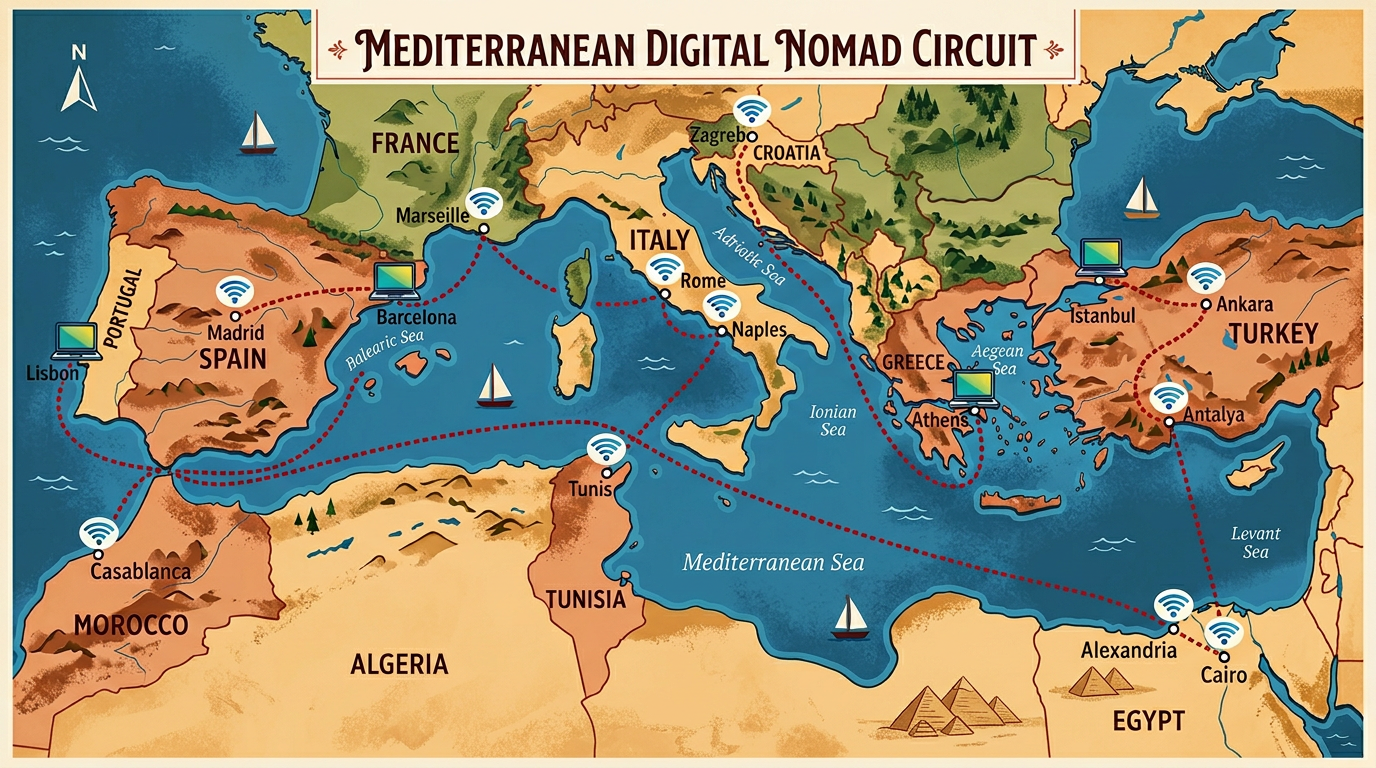
Strategy 1: The Regional EU eSIM Plan (Simplest)
If your Mediterranean trip stays inside the EU — Spain to France to Italy to Greece, or Croatia to Malta to Portugal — a single European regional eSIM is the cleanest choice. One plan, 40+ countries, no reinstallation between borders. Real pricing: 10GB / 30 days is $22.80, 20GB / 30 days is $38.40, 50GB / 180 days is $93.60. Best for nomads staying inside the EU for a month or longer.
Strategy 2: The Country-Hopper (Best Per-GB Price)
Buy a fresh country-specific eSIM each time you cross into a new country. Works well if you are staying 1 – 3 weeks per country and each destination has affordable local pricing. Often the cheapest per gigabyte — for example, Turkey 20GB / 30 days at $8.40 works out to $0.42 per GB, significantly cheaper than any regional plan. Trade-off: you manage multiple eSIM profiles.
Strategy 3: The Hybrid eSIM Approach (Most Flexible)
Keep one regional EU plan active as your always-on backbone, then add local country plans when you cross into non-EU territory (Turkey, Morocco, Egypt) or when you land in an island/rural area where you want a dedicated local connection. Best for nomads with mixed EU/non-EU itineraries and higher data needs.
Matching Your Mediterranean Itinerary to the Right eSIM Strategy
Here is what the three strategies cost in practice for common Mediterranean itineraries, using current UpApp pricing:
| Trip Type | Best eSIM Strategy | Actual UpApp Price |
|---|---|---|
| EU-only loop, 1 month (Italy → Greece → Spain) | Europe 40+ regional eSIM, 20GB / 30 days | $38.40 |
| EU + Balkans (Italy → Croatia → Montenegro → Albania) | Europe regional 10GB + per-country Balkans plans | ~$30 – $45 combined |
| North Africa (Morocco → Tunisia → Egypt) | Country-specific eSIMs (10GB each) | ~$35 – $45 combined |
| Grand Mediterranean (Spain → France → Italy → Greece → Turkey) | Europe 40+ 20GB + Turkey 10GB 30-day plan | $38.40 + $5.04 = ~$43 |
| Remote worker, 1 month in Portugal | Portugal 20GB / 30 days | $12.72 |
| Greek island hopping, 2 weeks | Greece 10GB / 30 days OR Europe regional | $7.32 – $11.88 |
| Morocco deep dive, 1 month | Morocco 20GB / 30 days | $20.16 |
| Istanbul + Cappadocia, 2 weeks | Turkey 10GB / 30 days | $5.04 |
Two observations from running these numbers. First, the regional EU plan wins dramatically for any itinerary staying inside the EU for a month — at $38.40 for 20GB across 40+ countries, you pay roughly $1.92 per GB instead of $3 to 5 per GB with home-carrier roaming. Second, individual country plans in Mediterranean hubs are often cheaper than the regional plan if you are only in one country — Portugal 20GB for $12.72 beats the Europe plan at $38.40 if you are only in Lisbon for a month.
Mediterranean Digital Nomad Visas: 2026 Requirements and Costs
If you are staying longer than 90 days, the Schengen 90/180 rule becomes a real constraint for non-EU passport holders. Fortunately, most Mediterranean countries now offer dedicated digital nomad visas:
| Country | Visa Name | Duration | Income Requirement |
|---|---|---|---|
| Spain | Digital Nomad Visa | Up to 5 years | ~€2,650/month |
| Portugal | D8 Digital Nomad | 1 year, renewable to 5 | ~€3,280/month |
| Italy | Digital Nomad Visa | 1 year, renewable | ~€28,000/year |
| Greece | Digital Nomad Visa | 1 year, renewable to 3 | €3,500/month |
| Croatia | Digital Nomad Residence Permit | Up to 1 year | ~€2,540/month |
| Malta | Nomad Residence Permit | 1 year, renewable to 4 | €3,500/month |
| Cyprus | Digital Nomad Visa | 1 year, renewable to 3 | €3,500/month |
| Turkey | Digital Nomad Visa | Up to 1 year | $3,000/month |
A few practical notes:
- Portugal's D8 and Spain's Digital Nomad Visa lead to residency and potentially citizenship — the biggest long-term play
- Croatia's permit is non-renewable — you must leave 90 days before reapplying
- Italy's program is newer and still evolving; processing times can be long
- Turkey's nomad visa requires no connection to Schengen, useful for restarting your 90/180 clock
- Malta and Cyprus offer the fastest processing for smaller countries with English-speaking admin
Building a Connectivity-Smart Nomad Itinerary
Anchor Your Deep-Work Weeks in Strong-Coverage Cities
Heavy video call weeks, product launches, client-facing work → Lisbon, Barcelona, Tel Aviv, Milan, Valletta. These cities have fiber coworking spaces and mature 5G networks. Do not schedule a product launch from a Greek island.

Save Islands and Rural Areas for Async Work Weeks
Creative work that does not depend on real-time calls — writing, design, coding with occasional push, async management — is where islands shine. Santorini, Hvar, Corsica, Malta's Gozo all work beautifully if your work pattern is asynchronous.
Use Non-EU Countries to Reset the Schengen 90-Day Clock
After 90 days in Schengen, spend 30 to 90 days in Turkey ($5.04 for 10GB / 30 days), Montenegro ($7.92), Albania ($8.63), Morocco ($11.88), or Egypt ($14.64). All are affordable, have established nomad scenes, and let you return to Schengen with a fresh 90-day allowance. Istanbul in particular has become a serious nomad hub in 2025 – 2026.
Always Have a Backup Connection
The single biggest mistake nomads make is relying on one connection method. Hotel WiFi dies during your client call. The coworking router reboots. Your eSIM hits its fair use limit. The fix is always having a second option — either a secondary eSIM profile, a local SIM for emergencies, or mobile hotspot capability from your phone to your laptop. Redundancy is not optional when your income depends on connectivity.
Real Cost Comparison: 3 Months of Mediterranean Connectivity
Let us compare the actual cost of staying connected for a 3-month Mediterranean circuit — starting in Lisbon, moving through Spain and Italy, spending a month in Greece, then a side trip to Istanbul:
| Option | Cost |
|---|---|
| Option A: Home carrier roaming (US/AU/CA, ~$10/day pass) | $900 – $1,400 |
| Option B: 5 separate local SIMs + KYC in each country | $100 – $200 + hours of setup |
| Option C: UpApp Europe 20GB × 2 months + Turkey 10GB | $81.84 total |
The math speaks for itself: UpApp's eSIM strategy costs roughly 9% of home-carrier roaming ($81.84 vs $900 – $1,400), and is only marginally more expensive than juggling 5 local SIMs with the paperwork and language barriers. For a nomad whose time is billable, that margin is erased in the first hour saved at an airport SIM kiosk.
Frequently Asked Questions
Can I use one eSIM across the entire Mediterranean region?
Not quite — the EU part of the Mediterranean is covered by a European regional plan (40+ countries), but non-EU countries (Turkey, Morocco, Egypt, Albania, Montenegro) require separate country-specific eSIMs or are covered by different regional plans.
Is EU roaming from a Spanish or Italian SIM enough for multi-country travel?
Inside the EU, yes — for a while. Fair use policy limits EU roaming for stays longer than a few weeks in another EU country. The moment you cross into Turkey, Morocco, or Egypt, roaming becomes very expensive. A dedicated travel eSIM avoids both issues.
What is the best digital nomad city in the Mediterranean in 2026?
Lisbon remains the most popular all-around choice — strong nomad community, excellent connectivity, D8 visa, manageable cost of living. Barcelona and Valencia are close seconds. Istanbul is rising fast as a non-EU alternative with great food, culture, and affordability.
How do I manage the Schengen 90/180 day rule as a digital nomad?
Plan your itinerary around it. Spend 90 days maximum in Schengen, then rotate to non-Schengen (Turkey, Albania, Montenegro, Morocco, Egypt, UK) for at least 90 days before re-entering. EES now tracks this automatically — overstays result in entry bans.
Is 20 GB of mobile data a month enough for a digital nomad?
If you work primarily from WiFi and use mobile data for travel, messaging, and occasional tethering: yes, 20 GB is usually enough. If you regularly tether your laptop or do video calls on cellular: plan for 30 – 50 GB per month.
What happens to my eSIM when I fly home between trips?
It stays on your phone, inactive, until you travel again — or delete it. UpApp eSIMs have a 180-day pre-install window, and top-up keeps your profile reusable on your next trip.
The Bottom Line: Mediterranean eSIM Strategy for Digital Nomads
The Mediterranean is one of the best regions in the world for digital nomads — dense concentration of nomad-friendly cities, diverse cultures, excellent food, manageable distances between countries, and a growing set of digital nomad visas. The one thing it asks of you is intentionality.
Visa rules, Schengen limits, zone boundaries, connectivity variance, and island infrastructure all demand that you plan rather than wing it. The nomad who shows up with a one-size-fits-all phone plan and a vague itinerary will burn money and time in equal measure. The nomad who maps connectivity to work pattern, anchors deep-work weeks in strong-coverage cities, and rotates through non-Schengen countries to reset the 90-day clock — that nomad stays productive, solvent, and in the region for years.
A smart eSIM strategy is a small part of this bigger picture, but it is the part you can solve in 5 minutes before you fly. At $81.84 for three months of Mediterranean connectivity, it is also the cheapest part of the trip.
Start with our European regional eSIM for 40+ countries on one plan (20GB / 30 days for $38.40), or browse country-specific plans for non-EU legs of your trip. Activate in 30 seconds with our setup guide — and land in your next Mediterranean city ready to work, not queuing for a SIM kiosk.