Unlimited Daily vs Fixed GB eSIM: Which Plan Actually Saves You Money?
You are about to buy an eSIM for your trip. Two plans catch your eye. The first promises "unlimited data" with 3GB per day at full speed, for four days. The second gives you 20GB spread across 30 days, full speed all the way through. The prices are almost identical.
Which one is better?
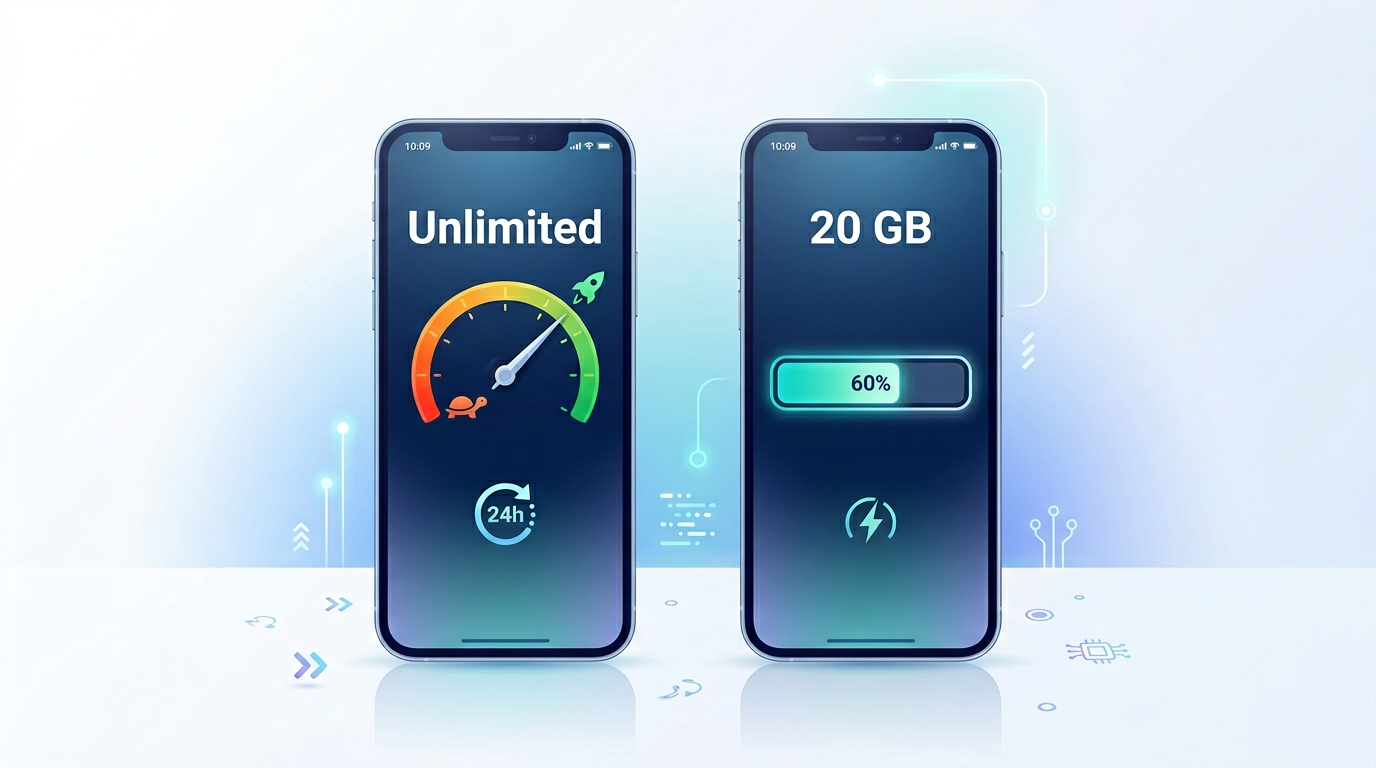
The honest answer is: it depends — but not in the way most eSIM websites would have you believe. Holafly pushes unlimited plans hard. Airalo pushes fixed gigabyte plans hard. Both are selling you their business model, not answering your question.
This guide cuts through the marketing. We will look at what "unlimited" actually means, how much data real travelers use, and how to calculate the true price per gigabyte — so you can choose the plan that fits your trip, not the one a provider wants you to buy. Once you know what you need, check current eSIM prices by country or browse plans for 170+ destinations.
The Truth About "Unlimited" eSIM Data Plans
Let us start with the uncomfortable part. There is no such thing as truly unlimited mobile data. Every "unlimited" plan on the market has a fair use policy — a daily cap on full-speed data, after which your connection is throttled to a much slower speed.
What "Unlimited Data" Really Means for eSIM Plans
A typical "unlimited" eSIM plan works like this: you get a set amount of high-speed data per day (often 1GB, 2GB, 3GB, or 5GB). Once you hit that daily cap, the provider does not cut you off — they slow your connection down to anywhere between 128 kbps and 512 kbps.
For context: 128 kbps is slower than a dial-up modem from 2001. At 512 kbps you can send a WhatsApp message, load a plain text webpage, and maybe stream audio in low quality. What you cannot do at throttled speeds:
- Stream video in any watchable quality
- Make a smooth video call
- Upload photos or stories to Instagram quickly
- Load modern webpages with images in reasonable time
- Use Google Maps with satellite imagery
Key takeaway: "Unlimited" means unlimited messaging and basic tasks, plus a set amount of genuinely fast data per day. Once you understand that, the comparison with fixed GB plans becomes much clearer.
What Still Works After the Daily Throttle
- Text messaging (WhatsApp, iMessage, Telegram)
- Basic email (plain text, no attachments)
- Google Maps navigation (if already loaded)
- Audio streaming at low bitrate (Spotify low quality)
- Voice calls over IP (spotty)
How Much Mobile Data Do Travelers Actually Use Abroad?
Before you pick a plan, you need to know what you are actually buying. Here is what common activities consume:
| Activity | Typical Data Use | 1 Hour = |
|---|---|---|
| WhatsApp / iMessage (text) | ~10 MB per day | Negligible |
| Google Maps navigation | 5 – 10 MB per hour | ~8 MB |
| Email & web browsing | 60 MB per hour | ~60 MB |
| Instagram / TikTok scroll | 100 – 300 MB per hour | ~200 MB |
| Spotify streaming | 40 – 150 MB per hour | ~100 MB |
| Video call (WhatsApp/Zoom) | 300 – 500 MB per hour | ~500 MB |
| YouTube SD | 500 MB per hour | ~500 MB |
| YouTube / Netflix HD | 1.5 GB per hour | ~1,500 MB |
| 4K streaming | 7 GB per hour | ~7,000 MB |
Traveler Data Profiles: Which One Are You?
Honest self-assessment matters more than marketing promises. Which of these best describes your trip?
| Traveler Profile | Daily Usage | Typical GB / Day |
|---|---|---|
| Light | Maps, messaging, occasional browsing. Mostly on WiFi. | 0.2 – 0.5 GB |
| Medium | Social media, maps, photos, some streaming. | 0.5 – 1.5 GB |
| Heavy | Video calls, streaming, live stories, constant mobile data. | 2 – 5 GB |
| Power user | Remote work, 4K streaming, tethering laptop. | 5+ GB |
A practical rule: most travelers overestimate their data needs by a factor of two or three. If you think you will use 2GB per day, you will probably use 800MB to 1GB — unless you are specifically streaming or video calling on mobile data.
When Unlimited Daily eSIM Plans Win
There are specific situations where an unlimited plan is the smarter buy, even at a higher price per gigabyte:
Short, Intense Trips (2 – 5 Days)
On a weekend city break you are not optimizing for cost per gigabyte — you are optimizing for peace of mind. You want to navigate unfamiliar streets, share stories, FaceTime home, and not think about the meter running. A 4-day trip to Istanbul or Bangkok is a textbook case — a daily refresh of 3GB means you always wake up to a full tank.
Heavy Data Users While Traveling
If you stream music while walking, upload Instagram stories throughout the day, FaceTime family nightly, and binge Netflix in the hotel, a fixed 10GB plan for 30 days will be gone in three days. Unlimited daily plans cap your speed after the daily quota, but they never cut you off.
Travelers Without Reliable Hotel WiFi
Camping trips, road trips, cruise stops, small towns, rural destinations — anywhere hotel WiFi is weak or nonexistent — an unlimited plan keeps you online without rationing.
Peace of Mind Over Price Optimization
Some travelers genuinely dislike tracking data usage. If checking your remaining gigabytes stresses you out, the few extra dollars for an unlimited plan buys you a vacation without that anxiety. That is a legitimate reason to choose one.
When Fixed GB eSIM Plans Win
Longer Trips (7+ Days)
Over a week or two, the math shifts dramatically. A 20GB plan for 30 days at full speed usually costs less than stacking two unlimited weekly plans back to back — and gives you full speed the whole time instead of a daily throttle.
Travelers With Good WiFi Access at Accommodation
If you stay in hotels, Airbnbs, or cafés with reliable WiFi, most of your heavy data use (Netflix, video calls, photo uploads, app updates) happens on WiFi anyway. Your mobile data is there for maps, messaging, and the occasional browsing session — activities that rarely exceed 500MB to 1GB per day.
Multi-Country Trips With Regional eSIM Plans
Regional eSIM packages almost always come as fixed gigabyte plans. If you are moving between countries — Thailand to Vietnam to Indonesia, or Spain to France to Italy — a regional plan covering the whole trip is cleaner than juggling multiple unlimited country plans.
Better Price Per GB for Disciplined Travelers
If you know your habits — mostly messaging and maps, heavy downloads only on WiFi — a fixed plan gives you more actual gigabytes for your money. You are paying for data, not for the "just in case" buffer.
The Real Math: eSIM Price Per GB Comparison
Let us run actual numbers. Using representative eSIM pricing for a popular destination (Thailand), here is what each plan really costs per usable gigabyte:
| Plan | Plan Price | Usable Data | Price / GB |
|---|---|---|---|
| Unlimited 3GB/day × 4 days | $19 | ~8 – 10 GB realistic | ~$2.10 |
| 20GB / 30 days (full speed) | $22 | 20 GB full speed | ~$1.10 |
| Unlimited 2GB/day × 7 days | $27 | ~12 – 14 GB realistic | ~$2.00 |
| 10GB / 30 days (full speed) | $15 | 10 GB full speed | ~$1.50 |
A few things jump out from this table.
First, fixed GB plans are almost always cheaper per gigabyte. The 20GB / 30-day plan costs roughly half as much per GB as the equivalent unlimited plan. If you are a price-conscious traveler and you know your usage is moderate, fixed wins.
Second, the "usable data" column on unlimited plans is an estimate. In reality, if you hit the daily cap on day one, you get 3GB of fast data and then throttled speeds. That throttled data is technically unlimited, but practically useless for most activities.
Third, unlimited plans cost more, but they buy you something fixed plans cannot: a daily reset. You can burn 3GB streaming YouTube on a long train ride, and tomorrow you wake up with a fresh 3GB.
eSIM Plan Decision Framework: Four Questions to Ask Yourself
- How many days am I traveling? Under 5 days: unlimited often wins. Over 7 days: fixed GB usually wins.
- How many hours per day am I using my phone off WiFi? Less than 4 hours: fixed GB. More than 6 hours of active use: unlimited.
- Do I stream video or do video calls on mobile data? Yes regularly: unlimited. Only on WiFi: fixed GB.
- Am I returning to the same country within 30 days? Yes: fixed GB — leftover data carries forward, better value. No: either works.
Best eSIM Plan Recommendation by Trip Type
Matching common trip patterns to the right plan:
| Trip Type | Best Plan Type | Why |
|---|---|---|
| Weekend city break (2 – 3 days) | Unlimited daily | No time to monitor usage, likely heavy social media and navigation. |
| 1-week vacation | Fixed GB (10 – 15 GB) | Hotel WiFi covers big downloads, mobile data for maps and messaging. |
| 2-week multi-city Europe trip | Regional fixed GB | Full speed throughout, covers multiple countries on one plan. |
| Digital nomad (2+ weeks) | Fixed GB (larger plan) | Better price per GB, WiFi access most of the time. |
| Business trip with video calls | Unlimited daily | Video calls burn data fast, no bill surprises during meetings. |
| Backpacking multi-country | Regional fixed GB | One plan, several countries, predictable cost. |
| Remote work trip (tethering) | Fixed GB (large) or unlimited | Depends on laptop workload. Heavy video = unlimited. |
One more honest recommendation: if you are unsure, start with a smaller fixed plan (5GB – 10GB). You can always top up or add a second eSIM profile if you run out. That approach costs less than defaulting to an expensive unlimited plan "just in case." Browse plans by destination on our country page to see what each option costs.
Frequently Asked Questions
Is 1GB of eSIM data per day enough for travel?
For most travelers, yes. 1GB per day covers navigation, messaging, social media scrolling, and a reasonable amount of browsing. If you are streaming video or doing video calls on mobile data (not WiFi), 1GB will not be enough.
What happens when I use all my eSIM data?
On a fixed GB plan, your connection typically stops until you top up or buy a new plan. On an unlimited plan, you keep getting data but at a heavily throttled speed (128 – 512 kbps) for the rest of the day, until the daily cap resets.
Can I top up an eSIM plan instead of buying a new one?
Yes, with most providers. Topping up is usually cheaper and simpler than activating a new eSIM — and it preserves your existing profile so you do not have to set up the device again. Check your provider's app for top-up options.
Do unlimited eSIM plans really give unlimited data at full speed?
Not in the way most people imagine. Every unlimited plan has a fair use policy — a daily high-speed cap, after which you are throttled to slow speeds for the rest of the day. You keep getting data, but not at usable speeds for video, streaming, or heavy browsing.
Is it better to buy multiple small eSIMs or one large plan?
One big plan is almost always cheaper per gigabyte and easier to manage. Multiple small eSIMs make sense only if you are visiting different countries without a good regional plan option, or if you are testing a new provider before committing.
How do I check how much eSIM data I have left?
Most eSIM provider apps show real-time data usage. You can also check your phone's cellular data settings, though the numbers there reset differently than your plan does. The provider app is the source of truth.
The Bottom Line: Unlimited vs Fixed GB eSIM Plans
Unlimited and fixed GB plans are not good or bad — they are tools for different jobs. Unlimited rewards short, intense usage and peace of mind. Fixed GB rewards longer trips, disciplined usage, and better price per gigabyte.
The mistake most travelers make is buying unlimited "just in case" — paying twice as much per gigabyte for data they will never use. The opposite mistake is buying the smallest fixed plan available, then running out on day three of a seven-day trip and paying for an emergency top-up at worse rates.
Match the plan to your actual travel pattern, not to the marketing. Short and intense: unlimited. Long and moderate: fixed. When in doubt, estimate your daily usage honestly, add a 20% buffer, and pick the fixed GB plan closest to that total.
Browse UpApp eSIM plans for 170+ countries or explore regional multi-country packages. Travel connected — without overpaying.