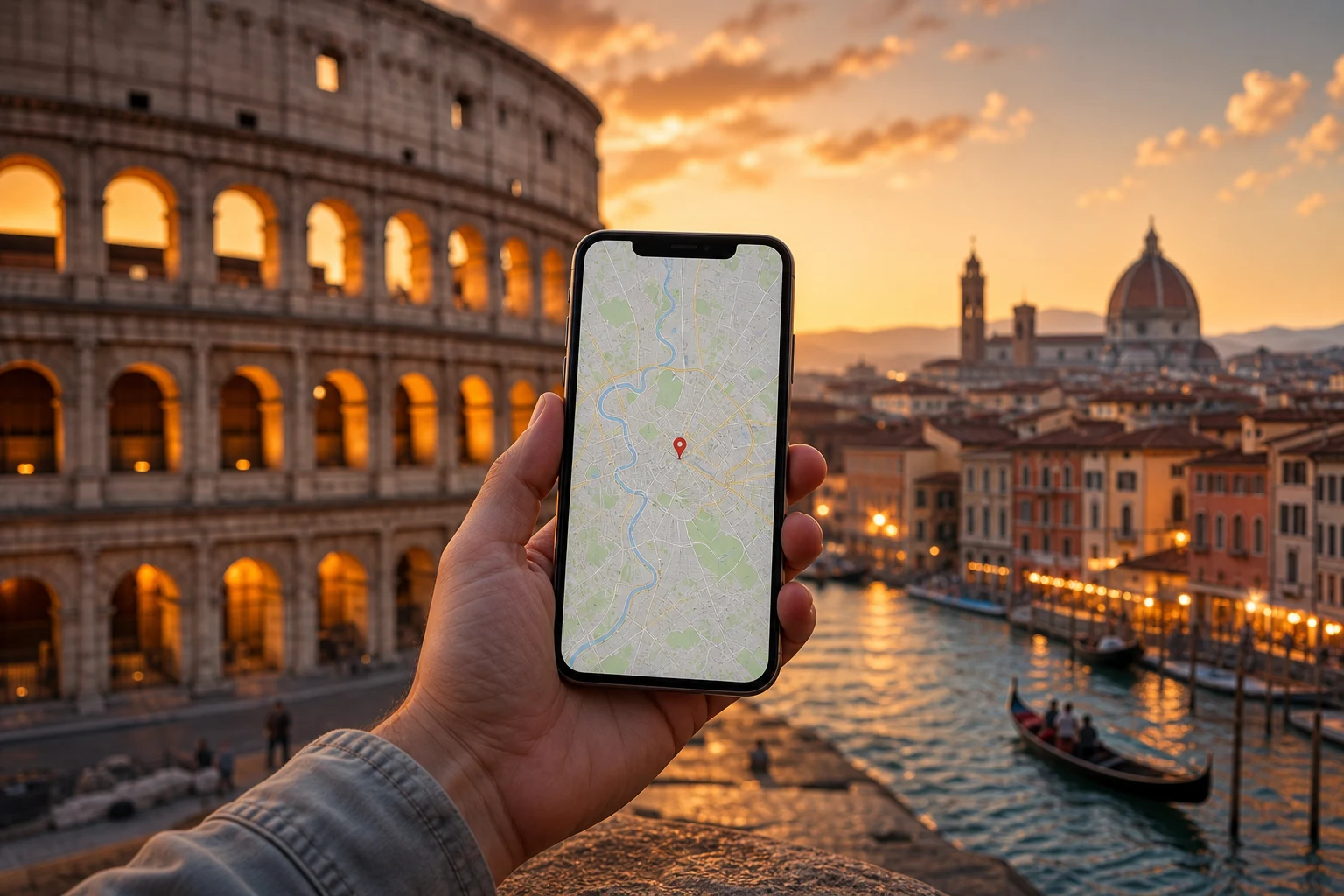
Best eSIM for Italy: Stay Connected in Rome, Venice, Milan and Florence
Italy is one of those countries where you think you can figure it out when you land. Then you arrive. You need Google Maps to find your hotel in a neighbourhood with no street logic. You need WhatsApp to tell your host you are outside. You need the Trenitalia app to check which platform your train leaves from. You need your email for the museum ticket QR code. You need translation when the waiter describes the specials. And suddenly, airport Wi-Fi — which cuts out the moment you step past security — is very much not enough.
That is why buying an Italy eSIM before you leave home is one of the simplest travel decisions you can make. Five minutes of setup. No SIM card kiosk. No roaming surprise on the next credit card statement.
This guide covers everything: why mobile data matters more in Italy than most travellers expect, what your options actually cost, a city-by-city breakdown for Rome, Venice, Milan and Florence, and how to choose the right plan for your trip length. All UpApp prices are real retail prices at the time of writing. An Italy eSIM on UpApp starts at €0.95 for 1 GB / 7 days, with the most popular plan — 10 GB / 30 days — at just €5.65.
Why Mobile Data Matters More in Italy Than You Expect
Italy is not a single destination. It is four or five cities strung together by high-speed trains, with a completely different street logic in each one. A week in Italy typically means Rome for a few days, Florence, a night train to Venice, maybe Milan on the way out. That is four cities, four airport or station navigations, four hotel check-ins, and about forty moments where your phone is the only thing standing between you and being completely lost.
The practical list is longer than most people plan for:
At the airport
Ride-hailing apps (Uber operates in Rome and Milan), taxi booking confirmations, train schedules, hotel directions, terminal maps.
In the city
Google Maps in places where street signs are tiny, inconsistent, or in Latin. Restaurant reservations via TheFork or direct booking links. WhatsApp for Airbnb or apartment hosts. Translation when menus have no English version.
At museums and attractions
QR code tickets for the Colosseum, the Vatican Museums, the Uffizi Gallery and the Duomo all require a working internet connection to display correctly. A screenshot sometimes works. Sometimes the scanner requires a live connection.
On trains
Trenitalia and Italo apps for platform updates, delays, and seat changes. PDF tickets sometimes need cellular data to load correctly.
In an emergency
Maps to the nearest pharmacy, clinic or embassy. Your travel insurance contact details. The ability to make a call.
None of this is exotic. All of it is routine modern travel. And all of it requires mobile data.
The Roaming Reality: What It Actually Costs
Here is where most travellers get caught.
For EU and EEA residents travelling to Italy, roaming is covered under the EU's Roam Like at Home rules. If you have a German, French, Croatian or Slovenian SIM, you use your home data allowance in Italy at no extra charge — subject to fair-use policies, which vary by carrier and plan.
For everyone else — travellers from the US, UK, Canada, Australia, the Middle East, the Western Balkans, Turkey, Brazil, and most of the world — international roaming in Italy can cost anywhere from €3 to €15 per day depending on your carrier's add-on pricing. Some carriers charge per megabyte with no daily cap. One wrong setting, one auto-updating app in the background, one forgotten data roaming toggle, and the bill arrives three weeks later.
The math is simple. A typical 5-day Italy trip with basic data usage — maps, WhatsApp, email, a few restaurant lookups — can cost €25 to €75 in roaming charges depending on your carrier. An Italy eSIM on UpApp covering the same trip costs around €3 to €6.
One careless day of international roaming can cost more than the mobile data you actually needed for your whole trip. That gap is why eSIMs exist. It is not a niche travel product — it is just cheaper, and it is available in 30 seconds before you leave home.
Italy eSIM vs Roaming vs Local SIM: What Is Actually Better?
There are three ways to handle mobile data in Italy. Here is an honest comparison:
| Option | Best for | Main limitation |
|---|---|---|
| International roaming | EU/EEA travellers with good fair-use allowance | Expensive or unreliable for non-EU travellers |
| Local Italian SIM | Long stays, travellers needing a local number | Requires shop visit, ID process, physical SIM, Italian language |
| Italy travel eSIM | Tourists, short trips, multi-city itineraries | Requires an eSIM-compatible phone |
For a tourist on a 5 to 14-day Italy trip, the local SIM argument barely holds up. You land at Fiumicino or Malpensa, you need data immediately for the transfer to the city, and the TIM or Vodafone shop may be closed, queued, or in the non-Schengen part of the terminal. The eSIM is already on your phone. You flip one toggle.
The one case where a local SIM wins: stays longer than 3 to 4 weeks, where you need a local Italian number for callbacks, deliveries, or longer-term accommodation. For everyone else, an eSIM is faster, cheaper, and requires no physical interaction at all.
Real UpApp Pricing for Italy
These are current UpApp retail prices:
| Plan | Data | Validity | Price |
|---|---|---|---|
| Italy eSIM | 1 GB | 7 days | €0.95 |
| Italy eSIM | 3 GB | 30 days | €2.15 |
| Italy eSIM — Smart value | 5 GB | 30 days | €3.25 |
| Italy eSIM — Most popular | 10 GB | 30 days | €5.65 |
| Italy eSIM | 20 GB | 30 days | €9.60 |
| Italy eSIM — Heavy use | 50 GB | 30 days | €24.85 |
| Europe Regional | 1 GB | 7 days | €1.30 |
| Europe Regional | 5 GB | 30 days | €4.35 |
| Europe Regional — Most popular multi-country | 10 GB | 30 days | €8.55 |
| Europe Regional — Best value multi-country | 20 GB | 30 days | €16.10 |
| Europe Regional — Long stays | 50 GB | 90 days | €47.00 |
A 10 GB Italy plan for €5.65 covers a typical week-long trip for a single traveller using maps, social media, messaging, and the occasional video call. The 5 GB plan at €3.25 is the smartest pick if you only need maps and messaging. If you are travelling with a partner, need hotspot, or plan to upload a lot of content, step up to the 20 GB plan at €9.60. If your Italy trip connects to other European countries, the Europe regional eSIM covering most of Europe is often cheaper than buying two or three separate country plans — 10 GB for 30 days starts from €8.55.
How Much Data Do You Actually Need in Italy?
The most common question, and the answer depends more on your travel style than on Italy specifically.
| Trip type | Suggested data |
|---|---|
| Weekend city break (1 person) | 1 – 3 GB |
| 5 – 7 days in Italy (standard tourist) | 3 – 5 GB |
| Multi-city trip, 10 – 14 days | 5 – 10 GB |
| Heavy maps, social uploads, video calls | 10 GB+ |
| Hotspot for laptop, family sharing | Higher plan recommended |
A few practical notes. Google Maps uses roughly 5 – 10 MB per hour of active navigation — not much. WhatsApp, email, and light browsing add another 1 – 3 GB per week for most travellers. Uploading Instagram stories or TikTok content is where data disappears fast: a single 60-second video can be 50 – 150 MB. If you plan to share your connection with a laptop to work remotely, budget at least 10 – 15 GB per week.
Most travellers on a one-week city trip to Italy use between 2 and 6 GB. The 5 GB or 10 GB plan is the right call for most people — it leaves headroom without overpaying.
City-by-City Guide: Where You Will Actually Need Data in Italy
Rome: Airport to Hotel, Colosseum to Vatican
Rome is Italy's largest and most logistically complex city. The gap between the airport and where you actually want to be — a hotel near the Colosseum, a rental in Trastevere, an Airbnb in Prati — can mean 40 minutes by train, 60 minutes by taxi, or 90 minutes on the wrong bus if you misread the map.
The Leonardo Express from Fiumicino to Roma Termini is simple. But from Termini onward, Rome's street grid stops making sense to most visitors. Google Maps becomes the trip. And it needs a connection.
One practical note on the Colosseum: timed entry tickets are mandatory, non-transferable, and displayed as QR codes. If your phone is offline when the scanner checks your ticket, you are not getting in. A screenshot sometimes works. Sometimes it does not. The eSIM is the simpler solution.
Where mobile data matters most in Rome:
- Transfer from Fiumicino or Ciampino airport (train, bus, or ride-hailing)
- Navigation around the historic centre, which has no logical grid
- Colosseum, Roman Forum, and Palatine Hill tickets — QR code only, mandatory pre-booking
- Vatican Museums and Sistine Chapel — your confirmation is on your phone
- Trastevere, Campo de' Fiori, and Prati restaurant searches and reservations
- Translation in markets and at smaller restaurants
- Staying in contact with your group across a large, spread-out city
Venice: The One City in Europe Where You Genuinely Cannot Afford to Get Lost
Venice has no cars. It has no logical addresses by any standard map convention. It has over 400 bridges crossing 150 canals, and the walking routes between major landmarks loop, dead-end, and double back in ways that make even experienced travellers spend 20 minutes covering 300 metres.
The good news: Google Maps works extraordinarily well in Venice, including pedestrian routing through narrow calli and accurate vaporetto stop information. The bad news: it requires mobile data.
Venice has also introduced a day-tripper access fee on peak season dates, with QR-code verification at entry points. Penalties for non-compliance are substantial — enforcement is active.
Where mobile data matters most in Venice:
- Pedestrian navigation from Santa Lucia train station to your accommodation — this can take 30 – 60 minutes on foot and every street looks identical
- Vaporetto routes and real-time stop information
- Venice access fee QR code (required on peak season dates)
- Hotel, apartment, or B&B check-in coordination
- Gondola and water taxi bookings
- Restaurant search — the tourist traps are literally on the canals; the good places are two streets back
- Translation for menus and signage
Milan: Business Travel, Fashion Week, and Three Airports
Milan is Italy's most functional city for the traveller who needs to get things done. It is also the city with the most complicated airport situation in the country: three airports (Malpensa MXP, Bergamo BGY, and Linate LIN) spread across the metropolitan area, each requiring a different transfer to the city centre.
Bergamo in particular — heavily used by Ryanair and Wizz Air from the Balkans and Central Europe — requires a bus connection of 50 to 60 minutes to Milan centre. That bus departs from outside the terminal, runs to specific stops, and requires coordination that is considerably smoother with a working phone.
Where mobile data matters most in Milan:
- Airport transfer coordination from all three airports
- Train connections at Milano Centrale and Milano Porta Garibaldi
- Navigation around Duomo, Brera, Navigli, and Porta Nuova
- Business communication, email, and calendar during work visits
- Restaurant reservations — Milan has a strong booking culture; walk-ins at good places are difficult
- Payment confirmations for retail and shopping
Florence: Museum Tickets, Day Trips and the Most Pre-Booked City in Italy
Florence is compact — you can walk from the Uffizi Gallery to the Duomo in 10 minutes. But it is also the most aggressively pre-booked city in Italy. The Uffizi, Accademia (where David lives), Boboli Gardens, Brunelleschi's Dome climb, and most major attractions all require timed entry tickets purchased in advance. Those tickets are on your phone. And they need a live connection when scanned.
Florence is also the natural base for day trips: Pisa is 1 hour by regional train, Siena is 1.5 hours, Bologna and Cinque Terre are reachable within 3 hours. That means train research, return booking, and map loading from Florence for multiple destinations — all routine usage that adds up over 5 to 7 days.
Where mobile data matters most in Florence:
- Uffizi, Accademia, and Duomo Dome digital ticket display
- Walking routes between the major sites
- Restaurant bookings — a quick search separates the good spots from the tourist traps
- Day trip train research and booking for Pisa, Siena, Cinque Terre
- Translation at smaller restaurants and local markets
When Should You Install Your Italy eSIM?
Before you travel. This is not a recommendation. It is the correct answer.
Buying and installing an eSIM at the airport or after landing is possible, but it requires Wi-Fi, patience, and time you may not have when you are trying to navigate a transfer. The setup takes less than five minutes from home:
- Buy your Italy eSIM on UpApp — choose your plan based on trip length and data needs
- Install it via QR code or direct install — follow the UpApp setup guide for your device
- Keep your primary SIM active — it stays in your phone for calls and SMS at home rates
- Before landing in Italy, set your Italy eSIM as the active data plan in Settings
- Turn off data roaming on your primary SIM to prevent accidental charges
- Land. Open Maps. Go.
The eSIM activates automatically when it connects to an Italian network. You do not need to do anything else.
Italy eSIM or Europe eSIM: Which One Should You Buy?
The honest answer: it depends entirely on whether Italy is the only country on your trip.
Buy an Italy eSIM if:
- Your trip starts and ends in Italy
- You are doing a focused city break
- You want the cheapest per-GB cost for Italy specifically
- You are not crossing into Switzerland, France, Slovenia, or Austria
Buy a Europe regional eSIM if:
- Italy is part of a broader European trip
- You are combining Italy with Croatia, France, Germany, Spain, or any other EU country
- You are doing a road trip that crosses borders
- You are a digital nomad staying in Europe for a month or more
| Trip type | Best plan | UpApp price |
|---|---|---|
| Rome long weekend only | Italy 3 GB / 30 days | €2.15 |
| 1-week Italy multi-city | Italy 10 GB / 30 days | €5.65 |
| 2-week Italy + Croatia | Europe Regional 10 GB / 30 days | €8.55 |
| Italy + France + Spain road trip | Europe Regional 20 GB / 30 days | €16.10 |
| Italy digital nomad, 1 month | Italy 20 GB / 30 days | €9.60 |
Check Your Phone First: Not Every Device Supports eSIM
Most smartphones sold in the last 3 to 4 years support eSIM. What definitely works:
- iPhone XS and newer (including all iPhone 12, 13, 14, 15, and 16 models)
- Samsung Galaxy S20 and newer (note: some China-market models do not include eSIM hardware)
- Google Pixel 3a and newer
- Most 2023 – 2026 Android flagships from Sony, OnePlus, Motorola and others
What often does not work:
- Budget Android phones under €200
- Phones purchased directly in mainland China
- Some carrier-locked devices from specific markets
- Older models from 2018 and earlier
If you are not sure, check your phone settings: on iPhone, go to Settings → General → About and look for an EID number. On Android, go to Settings → Network → SIM cards → Add eSIM. If the option is there, your phone supports eSIM. For a full breakdown, see our complete eSIM compatibility guide.
Italy eSIM vs Unlimited Plan: Which Makes Sense?
Unlimited plans make sense if you are streaming video, making back-to-back video calls on cellular, or uploading large files. They are also priced for comfort, not economy.
Fixed-GB plans (like UpApp's 10 GB / 30 days at €5.65) make sense for almost every tourist use case in Italy: maps, messaging, social posting, email, train apps, and digital tickets. Very few travellers use more than 5 GB in a week of sightseeing.
UpApp's 10 GB Italy plan at €5.65 works out to roughly €0.57 per GB. A typical unlimited daily plan from major competitors costs significantly more per day for a standard Italy trip. For a deeper dive on this trade-off, see our breakdown of unlimited vs fixed GB eSIM plans.
Unless you are working remotely and streaming 4K content from your villa in Tuscany, a fixed-GB plan is the right call.
Frequently Asked Questions
Do EU roaming rules apply in Italy?
Yes — for EU and EEA residents with a home carrier SIM from within the EU/EEA, Italy is covered by Roam Like at Home rules. You use your home data allowance in Italy at no extra cost, subject to fair-use limits. For travellers from outside the EU — including the US, UK, Western Balkans, Middle East, and most of the world — EU roaming rules do not apply.
Can I keep my regular SIM active alongside an Italy eSIM?
Yes. Most modern smartphones support dual-SIM — one physical SIM and one eSIM simultaneously. Your regular SIM stays active for calls and SMS, while the Italy eSIM handles all data. Set the eSIM as your default data connection and turn off data roaming on the physical SIM.
Does an Italy eSIM work in rural areas, the Amalfi coast and Cinque Terre?
Italy has strong coverage from TIM, Vodafone Italia, and WindTre across major urban areas, tourist regions, and intercity train routes. For a standard tourist itinerary — Rome, Venice, Milan, Florence, the Amalfi coast, Cinque Terre — coverage is reliable. Signal can be weaker in deep mountain valleys or on remote sections of the coast, the same as anywhere in the world.
How does UpApp compare to Airalo, Holafly or Saily for Italy?
UpApp's Italy pricing is among the most competitive in the market — for example, €5.65 for 10 GB / 30 days. Unlimited-style plans from providers like Holafly are typically priced for comfort and short trips, while fixed-GB providers like Airalo and Saily are positioned around different per-GB economics. For most tourists, a fixed-GB plan with predictable cost is the better fit.
What happens if I run out of data in Italy?
You can top up directly through the UpApp, adding more data to your active plan without reinstalling or changing any settings. With UpApp, you buy more data and continue at full speed — no aggressive throttling like with some capped unlimited plans.
Can I share my Italy eSIM data as a mobile hotspot?
Yes — UpApp's Italy plans support hotspot and tethering. This makes a single 10 GB or 20 GB plan viable for couples or small groups who want to share one data connection rather than buying multiple eSIMs.
How long before my trip should I buy the Italy eSIM?
As early as you like — UpApp eSIMs have a 180-day pre-installation window. The plan validity (for example, 30 days) starts from the moment it first connects to an Italian network, not from the purchase date. Buy when you book your flights.
Italy eSIM or Europe regional eSIM — which one should I buy?
Buy a dedicated Italy eSIM if your trip starts and ends in Italy and you want the cheapest per-GB cost for the country specifically. Choose a Europe regional eSIM if Italy is part of a broader European trip — combined with Croatia, France, Germany, Spain or any other EU country, or if you are crossing borders during a road trip.
Will my Italy eSIM work for digital tickets at the Colosseum, Uffizi or Vatican?
Yes. Most major Italian attractions now use timed entry tickets delivered as QR codes that need to display correctly when scanned. With an active Italy eSIM and full mobile data, your tickets load reliably at the gate — no scrambling for airport Wi-Fi or hoping that a screenshot will be accepted.
Which phones support eSIM for an Italy trip?
Most smartphones from the last 3 – 4 years support eSIM, including iPhone XS and newer, Samsung Galaxy S20 and newer, Google Pixel 3a and newer, and most modern Android flagships. Budget Android phones under €200, devices bought directly in mainland China, and some carrier-locked models may not support eSIM. Check Settings → General → About on iPhone for an EID number, or Settings → Network → SIM cards on Android.
The Bottom Line: Italy Is Better When You Are Already Connected
Italy does not reward the traveller who figures it out on arrival. It rewards the traveller who knows which platform the train leaves from, who has the QR code ready at the museum entrance, who can translate the menu, and who can find the good restaurant two streets away from the tourist trap on the canal.
None of that requires an expensive phone plan. It requires a working data connection.
An Italy eSIM on UpApp starts at €0.95 for 1 GB / 7 days, with the most popular 10 GB / 30 days plan at €5.65. That is less than a single espresso at Fiumicino airport. It goes on your phone in five minutes before you leave home, activates automatically when you land, and works across Rome, Venice, Milan, Florence, the Amalfi coast, Cinque Terre, and everywhere in between.
Italy is not the place to waste money on roaming. It is the place to spend it on food, museums, trains, views and experiences.
For more background before you buy, see our guides on eSIM vs physical SIM, unlimited vs fixed GB plans, and our digital nomad's Mediterranean eSIM strategy.